
Why international customers abandon crypto checkout — and how to improve completion

Why international shoppers abandon crypto checkout, how mobile friction affects completion, and what can reduce cart abandonment in cross-border ecommerce.
An international customer can add a product to the cart, reach the payment page and still leave without paying. Cart abandonment is therefore not only a product or pricing issue. At crypto purchase, unclear instructions, too many actions, unfamiliar network choices and mobile friction can stop a buyer who has already decided to purchase.
In cross border ecommerce, this effect can be stronger because the buyer is already dealing with a foreign seller and a less familiar transaction flow. Shopping cart abandonment at this stage should be analysed separately from a failed transaction: the human may leave before any transfer is created.
Why customers abandon the purchase after deciding to buy
A customer who reaches crypto checkout has already shown purchase intent. At this point, completion depends less on persuasion and more on whether the flow is clear, predictable and easy to finish.
The first source of friction is uncertainty. A buyer may see a coin amount, network name, wallet address and QR code but not understand which elements are essential. If the page uses too much technical language, the buyer has to stop and interpret the interface instead of completing the order.
The second issue is the number of actions. The user may need to open a wallet, select an asset and network, check the amount, confirm the address, send funds and then return to the store. Every extra switch creates another chance to leave the flow.
This is why cart abandonment rate alone does not explain what went wrong. A merchant needs to know whether the buyer left before opening the payment form, after viewing the details or while switching to a wallet. Not every abandoned cart is a failed purchase: in many cases, no blockchain transaction exists yet.
For the payer-side process, including wallet, address and QR code steps, see "How to Pay with Cryptocurrency: Step-by-Step Guide for Beginners".
Why international and mobile crypto purchase creates more friction
International checkout adds another layer of uncertainty. In international ecommerce, the buyer may already be checking whether the seller is trustworthy, whether the price is final and whether the payment method works in their country. Crypto adds a few decisions that card users may not expect: which asset to use, which network applies and what happens after funds are sent.
The checkout should answer those questions before the customer has to search elsewhere. The buyer needs to know the exact amount, the asset, the network and the next action. They should not have to understand blockchain architecture to complete a purchase.
The mobile version deserves separate attention. A desktop flow cannot simply be reduced to a smaller screen. If the human is paying on the same phone used to open the checkout, switching between the browser and wallet becomes part of the user journey.
This is especially relevant to payment by QR code. A QR code is convenient when the buyer can scan it with another device. On the same smartphone, the checkout also needs a practical alternative, such as copying the address or opening the wallet directly when this is supported. The user should be able to return to the transaction page without losing the order context.
Cryptadium's current ecommerce flow follows this logic: the buyer selects a coin at checkout and can scan a QR code or open a wallet to continue the purchase. For a broader explanation of the infrastructure behind this flow, see "Understanding Crypto Payment Gateways: How They Work and Why Businesses Need Them".
What a simpler crypto checkout should show the customer
A good digital purchase does not try to teach blockchain technology during purchase. It gives the buyer only the information needed to complete the transaction correctly and understand what happens next.
First, the amount should be obvious. The buyer should see how much to send and in which asset. If a payment-related fee affects the displayed amount, the interface should make the total clear before the transfer.
Second, the asset and network must be presented as transaction parameters, not as a technical quiz. The user needs to know what to select for this specific order. Detailed explanations about network mechanics belong in support content, not in the critical transaction path.
Third, manual data entry should be reduced where possible. A long crypto address is easy to misread and inconvenient to type. QR codes, copy buttons and wallet-opening options can reduce unnecessary actions, depending on the device and integration.
Fourth, it should explain what happens after the customer sends funds. The buyer does not need a full status dictionary. A clear message that the transfer is being processed and that the order will update after the required processing step is usually more useful.
Fees can also affect how the buyer interprets the final amount, but their mechanics should not be mixed with checkout UX. Cryptadium explains processing and blockchain network fees separately in "Fees for cryptocurrency payments".
How businesses can improve completion without creating more complexity
To understand how to reduce cart abandonment, businesses should measure the transaction journey as a sequence of actions rather than treat every unpaid order as the same problem.
Start by separating cart abandonment from payment-stage abandonment. Then compare desktop and mobile flows. Identify the last completed action before the customer leaves: opening checkout, choosing coins, viewing the payment form, copying pay details, opening a wallet or returning to the store.
This creates a more useful picture than a single abandonment percentage. If buyers leave before they open a wallet, the problem may be clarity. If mobile users leave more often after viewing the payment form, the number of app switches or the same-device flow may need attention.
The next step is simplification. Remove fields that are not required for the transaction. Keep the amount, asset, network and next action visible. Use familiar wording where possible. Do not add a paragraph of instructions if one clear label or button can solve the same problem.
For cross border ecommerce, test the checkout as a first-time international customer, not only as an internal user who already knows the product. A clear flow should make sense without prior knowledge of the merchant's processes.
Improving completion is not about making crypto invisible. It is about making every necessary crypto-specific action understandable. The buyer should know what to pay, how to pay it and what will happen after the transfer without leaving the purchase to search for an explanation.
Before launching or updating a checkout, check that:
- the final amount, asset and network are visible without extra clicks;
- mobile users can copy details or open a wallet without losing the order context;
- the QR code is supported by a clear same-device alternative;
- technical terms are limited to information the customer actually needs;
- the next step after sending funds is clearly explained;
- desktop and mobile abandonment are measured separately;
- the team can identify where users leave the flow.
Businesses that want to integrate this flow into an online store can use Cryptadium's ecommerce solution with plugin, widget or API options.
The goal is a checkout that works as part of the order journey, not as a separate technical task. When details are clear, mobile actions are practical and the next step is predictable, international buyers have fewer reasons to abandon the purchase before the purchase is completed.
Read also
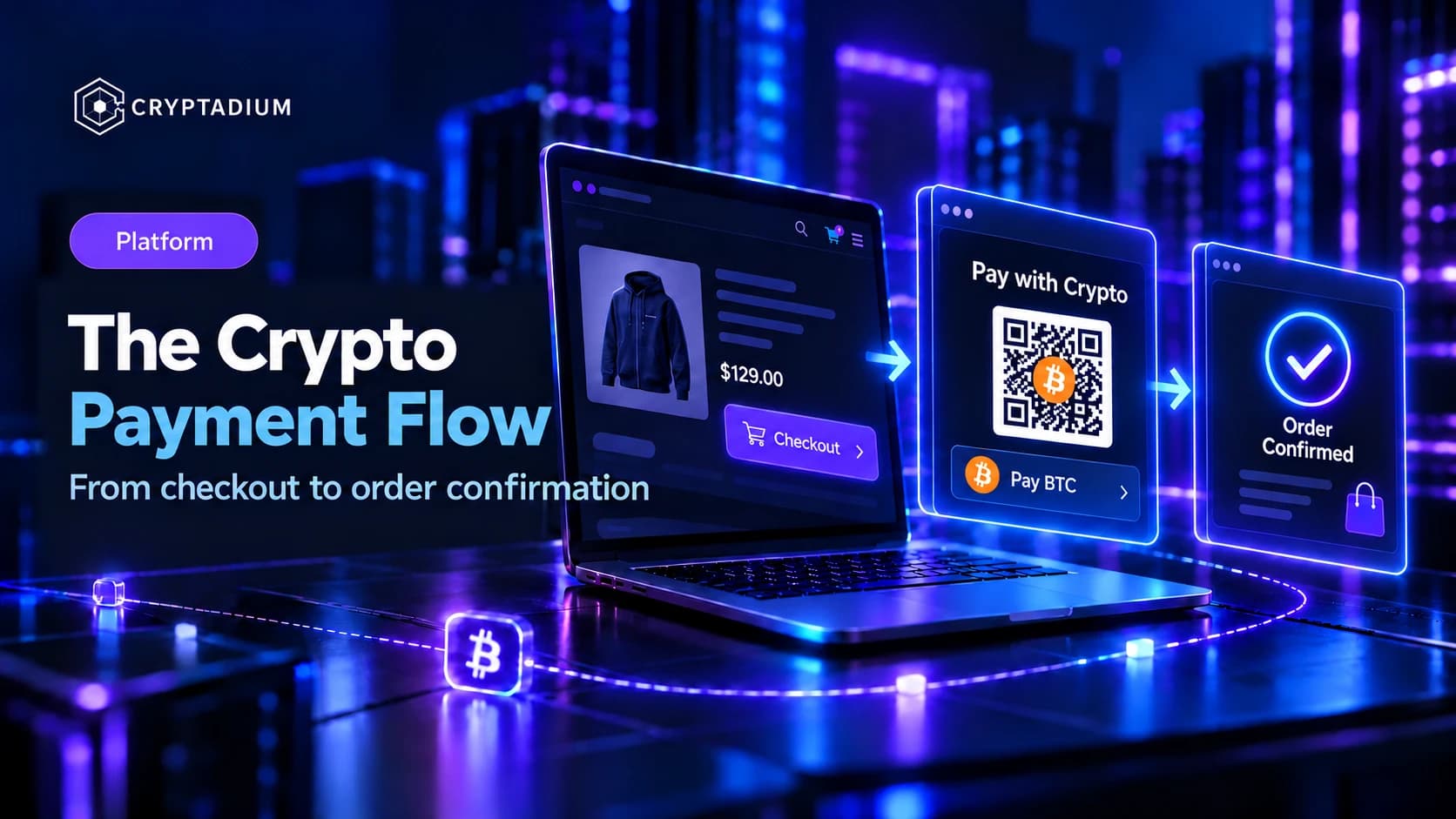
How a Crypto Payment Moves from Checkout to Order Confirmation
We break down how a crypto payment moves from checkout to order confirmation — what a TXID is, how blockchain confirmation works and when payment status updates the order.
Chargeback in Crypto: Can You Get Your Money Back or Dispute a Blockchain
Let's explore why a true chargeback is impossible in cryptocurrency, what risks remain for businesses, and how to protect yourself from losses.

Crypto Payments in EdTech: How Students Are Buying Courses in 2026
Cryptocurrency in education is predicted to directly influence the transformation of existing business models and the emergence of new ones.